Which AI Talking Avatar Looks Most Real? MiniMax H3, LongCat and More Side by Side in 4K
LongCat Avatar 1.6 turns one photo and one audio file into a lip-synced talking video on your own GPU; our 3-step preset runs 2.9x faster than 8 steps.
Published Oct 10, 2026 · 1,249 views · Watch on YouTube
Get the app and files
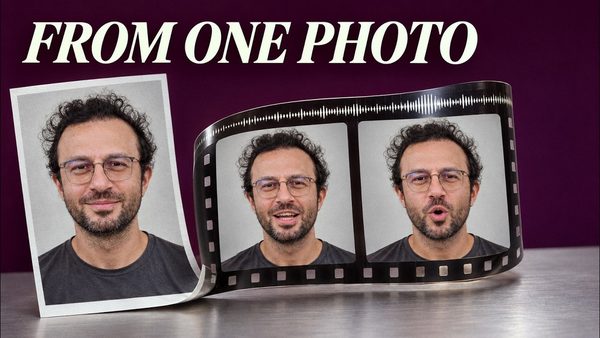
LongCat Avatar Tutorial: Turn Your Photo and Voice Into a Talking Video
LongCat Avatar 1.6 turns one photo and one audio file into a lip-synced talking video on your own GPU; our 3-step preset runs 2.9x faster than 8 steps.
Chapters
- 0:00 H3 + CodeFormer reference, AvatarForever and mouth-restored alternatives
- 0:10 Original LongCat, InfiniteTalk, FlashTalk and TalkingAvatar 2.0
- 0:20 LTX-2.5 guidance variants and LiveAvatar
- 0:30 MiniMax H3: four steps, eight steps and fifty steps
- 0:40 H3 mouth restoration, LatentSync, HighSync and single-reference generation
- 0:50 EchoMimic, OmniAvatar, FlashHead and TalkingAvatar variants
- 1:00 Wan 2.2, reference-image variants and short HuMo/LongCat tests
About this video
Which AI avatar would you choose? Compare 38 retained outputs and variants in a 4K side-by-side video, using the same portrait and driving audio. MiniMax H3 + CodeFormer remains in the top-left panel while five other results play beside it. Every panel shows the full portrait and an enlarged face detail, with readable model names, generation settings, source resolutions and frame rates. This is a compact visual comparison of tested recipes; the linked guides cover installation.
Links:
Download our ComfyUI ZIP and ready-to-use presets: [ https://www.patreon.com/posts/105023709 ]
Download our SwarmUI ZIP and ready-to-use presets: [ https://www.patreon.com/SECourses/posts/114517862 ]
Windows requirements video: [ https://youtu.be/DrhUHnYfwC0 ]
Updated Windows AI requirements guide: [ https://www.patreon.com/posts/111553210 ]
ComfyUI and SwarmUI installation tutorial: [ https://youtu.be/fTzlQ0tjxj0 ]
AI model downloader and SwarmUI installer: [ https://www.patreon.com/posts/114517862 ]
SECourses Discord: [ https://discord.com/invite/software-engineering-courses-secourses-772774097734074388 ]
SECourses community and updates: [ https://www.reddit.com/r/SECourses/ ]
You will learn how to inspect mouth shape, teeth, lip texture, facial identity, expression, glasses, beard detail and background stability across matching moments. Compare original and CodeFormer mouth-restored outputs. Watch the visible differences between four-step and eight-step H3 generation, the fifty-step non-Turbo recipe, LTX-2.5 guidance choices, lip-sync refiners and alternative avatar models.
Both Supplied H3 + CodeFormer and AvatarForever are available through our ComfyUI ZIP with these exact preset filenames:
MiniMax H3 Lip Synch - Audio + Text Image or Video - Turbo 4 Steps 832x1248 - 261001.json
AvatarForever Unified Image or Text + Audio To Long Video - 260920.json
The H3 preset saves the original result and a separate enabled CodeFormer mouth-pass result, using fidelity 0.9 and mouth blend 0.7. The current AvatarForever preset defaults to 832 x 1248. Use the download post for the current ZIP and setup instructions; this short comparison does not walk through installation or promise the same result from every input.
Main topics include MiniMax H3, CodeFormer mouth restoration, AvatarForever, LongCat Avatar 1.5 distilled and full models, InfiniteTalk, SoulX-FlashTalk 14B, TalkingAvatar 2.0 by Neosapience, LTX-2.5, LiveAvatar, LatentSync 1.6, HighSync, EchoMimic V3 Flash Pro, OmniAvatar 14B, SoulX-FlashHead Pro, Wan 2.2 Speech to Video and HuMo.
How to read the comparison: each round restarts the same source passage and preserves the videos' natural speed. The shared audio is played once, rather than mixing six soundtracks. A progress line tracks the passage. The full-result view preserves each source's aspect ratio; the face detail is a simultaneous crop from that same video. Labels identify the model, recipe and restoration pass.
The 38 outputs include settings and restoration variants, not 38 different base models. Seven rounds use the complete ten-second passage. The final round plays the complete first sentence alongside short HuMo, restrained-prompt LongCat and higher-resolution Wan clips, plus AvatarForever. Short video tails use labelled final-frame holds so the complete spoken passage remains audible.
Test scope: one portrait and a neutral passage, with different native resolutions, frame rates and generation settings. Judge identity, movement and mouth detail together. A sharper face does not by itself prove better lip sync. This video does not establish a universal model ranking, an emotional-performance benchmark, a hardware-speed comparison or a validated continuous lip-sync score. Visible artifacts remain in the tested results, including the ghosting in the two-reference H3 example, so you can inspect the tradeoffs yourself.
Use the chapters to compare model families, generation settings and mouth-restoration variants. The final chapter also includes the short first-sentence tests.
Chapters:
0:00 H3 + CodeFormer reference, AvatarForever and mouth-restored alternatives
0:10 Original LongCat, InfiniteTalk, FlashTalk and TalkingAvatar 2.0
0:20 LTX-2.5 guidance variants and LiveAvatar
0:30 MiniMax H3: four steps, eight steps and fifty steps
0:40 H3 mouth restoration, LatentSync, HighSync and single-reference generation
0:50 EchoMimic, OmniAvatar, FlashHead and TalkingAvatar variants
1:00 Wan 2.2, reference-image variants and short HuMo/LongCat tests
This video is for anyone choosing an AI talking-avatar workflow or comparing facial detail before experimenting with their own portrait and audio. Watch in 4K, pause on the labels, and compare the same mouth movement across panels.
For support, questions, installation help and future updates, check the links, the pinned comment, Patreon, Discord and the video comments. Tell us which result you prefer and which portrait or speaking style you would like tested next